 Tabby
The short version:
- Ask your clinic to show you once before you try at home.
- Warm the bag, prime the line so there's no air in it, and hang it above your cat.
- Lift a tent of loose skin between the shoulders, slide the needle in at the base, and open the clamp.
- Give the amount your vet prescribed, close the clamp, and remove the needle. A soft lump after is normal.
What sub-q fluids are, and why vets prescribe them
Subcutaneous (sub-q) fluids are a sterile fluid you drip under the loose skin of your cat's back. The body slowly absorbs it from there. It helps keep your cat hydrated.
Vets most often prescribe it for chronic kidney disease. Kidneys that don't work well let too much water out, so cats get dehydrated easily, even when they drink. Fluids at home can help them feel better. If your cat has kidney disease, our kidney disease care guide covers the bigger picture.
My own cat, Maça, lives with kidney disease. I know how scary a new treatment feels. The first time is the hardest. For many owners, it soon becomes a quiet few minutes of the day.
Only give fluids your vet prescribed, in the amount they set. The type of fluid, how much, and how often are your vet's decision. Too much fluid can be harmful, especially for cats with heart problems. Never change the amount on your own.
Ask the clinic to show you first
Before your first time at home, ask your vet or vet nurse to show you. Better still, ask to try it yourself while they watch. Ask them to write down the amount and how often, and keep it next to your supplies.
What you need
- A bag of fluid, the kind your vet prescribed.
- A giving set: the line (tube) with a clamp or roller that controls the flow.
- A new needle every time. Your clinic will tell you the size.
- A towel for your lap or the table, and to wrap a wriggly cat.
- Treats your cat loves.
- A sharps container for used needles.
Set up before you get your cat
- Check the bag. Look at the expiry date. The fluid should be clear, and the bag shouldn't leak.
- Connect the line to the bag, with the clamp closed. Try not to touch the ends.
- Prime the line. Open the clamp and let fluid run through until there are no air bubbles in the line. Then close it.
- Warm the bag to about body temperature. Put it in a bowl of warm water for a few minutes. Test it on your wrist. Never use a microwave. It heats unevenly and can make hot spots.
- Hang the bag higher than your cat, on a hook, door frame or coat hanger. Gravity does the work.
- Put the new needle on the end of the line. Keep its cap on until the last moment.
How to give a cat sub-q fluids, step by step
- Choose a calm, warm spot. Put your cat on your lap or on a table with a towel. Give a treat.
- Lift a tent of skin. Gently pinch the loose skin between the shoulder blades and lift it up. It makes a little triangle, like a tent.
- Insert the needle. Take the cap off. With the bevel (the slanted opening) facing up, slide the needle into the base of the tent, pointing along your cat's body, not down into it. One smooth, confident move is kinder than a slow one.
- Open the clamp. You should see fluid dripping in the drip chamber. Keep a light hold on the needle.
- Watch it flow until you've given the amount your vet prescribed. Most bags have marks on the side. Talk softly and offer treats.
- Close the clamp first, then gently pull the needle out.
- Pinch the spot for a few seconds, so less fluid leaks out.
- Reward your cat. Treats, praise, and letting them go about their day.
After: the lump, and the needle
Right after, you'll feel a soft, squishy lump under the skin. This is normal. It's the fluid waiting to be absorbed. It goes down over a few hours. It may slide lower as it does, towards a front leg or the belly. That's normal too.
Put the used needle straight into a sharps container, with no recapping. Never throw loose needles in the bin. Ask your clinic or pharmacy how to get rid of a full container.
If something goes wrong
- Fluid isn't flowing. Check the clamp is open. Gently move the needle a little, or turn it slightly. The tip may be against the skin. Make sure the bag is still high enough.
- The fur is getting wet. The needle probably went in one side of the tent and out the other. Close the clamp, take it out, and try again with a fresh needle.
- A little blood. A drop of blood can happen. Press gently on the spot for a minute. It's usually fine.
- Your cat jumps away. Close the clamp first. Calm things down, then try again with a new needle.
Tips that make it easier
- Use two people at the start: one to hold and stroke, one to do the fluids.
- Same time, same place every day. Cats relax when they know what's coming.
- Keep the room warm and quiet.
- Treats before, during and after. Some cats end up coming to the spot by themselves.
- Stay calm yourself. Your cat notices. It's okay to stop and try again later.
Was today's session done?
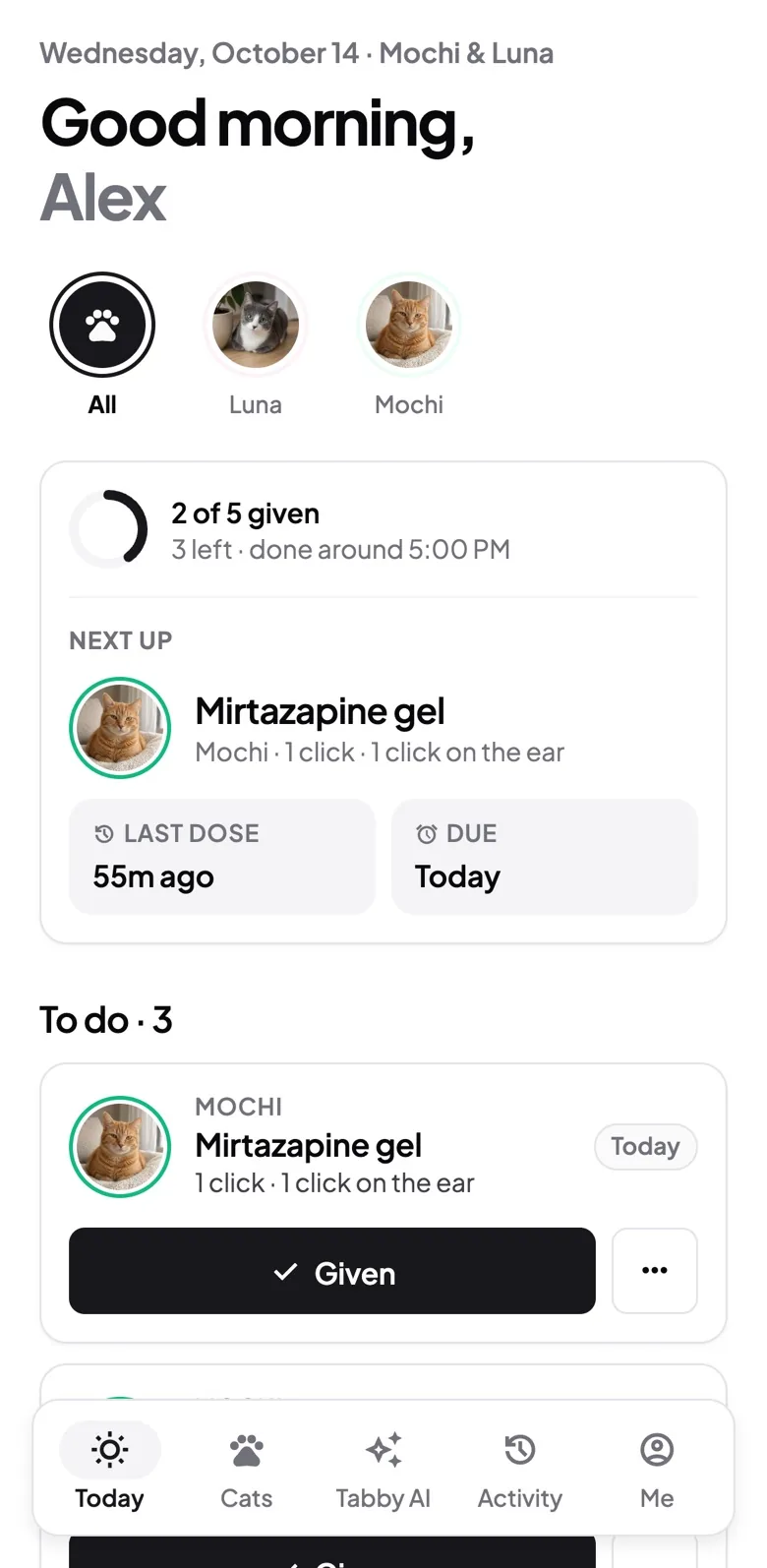
Fluids are easy to lose track of when more than one person helps. Log each fluid session in Tabby as part of the day's care, so the whole household knows it's done. A reminder tells you when the next one is due. Pills too: see our guide to giving a cat a pill.
When to call your vet
- The lump is still there the next day.
- The spot is red, hot, swollen or painful.
- Your cat is breathing fast or with effort, or coughing.
- Your cat looks puffy around the eyes.
- Your cat is unusually tired or quiet.
The last three can be signs of too much fluid. Call your vet straight away if you notice them. If you track several treatments, a cat medication chart makes it easier to tell your vet exactly what was given and when.
Questions people ask
Does giving sub-q fluids hurt my cat?
Most cats feel a quick pinch when the needle goes in, then very little. Cold fluid can feel unpleasant, so warm the bag first. Many cats come to accept it calmly once it is part of the routine.
Is the lump after sub-q fluids normal? How long does it take to absorb?
Yes, a soft, squishy lump is normal. It is the fluid waiting to be absorbed. It usually goes down over a few hours, and it may slide lower towards a leg or the belly as it does. If it is still there the next day, call your vet.
Can I reuse the needle for sub-q fluids?
No. Use a new, sterile needle every time. A used needle is blunter, so it hurts more, and it can carry germs into the skin. Put used needles straight into a sharps container.
What if my cat won't sit still for fluids?
Ask a second person to hold and stroke your cat, or wrap your cat loosely in a towel. Pick a calm time, keep the room warm, and give treats during and after. If it still doesn't work, ask your vet nurse for tips or a different setup.
This guide is general information from a cat owner, not veterinary advice. Always follow your vet's instructions for your cat's fluids and medicine.