 Tabby
The short version:
- Print the chart below and put it where the medicine lives.
- Write each medicine exactly as on the label, with its time.
- Tick the box and add your initials every time you give a dose.
- Missed a dose or not sure? Don't double up. Ask your vet.
Why a written schedule helps
When one person gives one medicine, memory is usually enough. Add a second medicine, a partner, a parent or a pet sitter, and it stops being enough fast.
- Shared care stays in sync. Anyone can glance at the chart and see what has been given today.
- No double doses. "Did you give it?" "I thought you did." A ticked box ends that conversation.
- A record for your vet. When your vet asks how the week went, you can show them instead of guessing.
Maça has kidney disease and gets medicine every day, and family helps. A single sheet everyone could see was the first thing that really worked for us.
The printable chart
Cat medication chart
- Cat's name
- Vet phone
- Week of
| Medicine | Doseas prescribed | Time | Mon | Tue | Wed | Thu | Fri | Sat | Sun | Given byinitials |
|---|---|---|---|---|---|---|---|---|---|---|
Tick the box and add your initials after every dose. Missed a dose or not sure it was given? Don't give it again. Call your vet. From tabby-care.com
How to fill it in
- Write the medicine exactly as on the label. Use the name on the box or the pharmacy sticker, not a nickname like "the white one". If you have two strengths of the same medicine, write the strength too.
- Copy the dose from the label or your vet's note. Don't work it out yourself, and don't change it without asking your vet.
- Add the time and any rules. For example "8am, with food" or "8pm, empty stomach". If a medicine is given twice a day, give it two rows, one for each time.
- Fill in the top. Your cat's name, your vet's phone number and the date the week starts. The phone number matters most when something goes wrong and you're in a hurry.
- Tick and initial straight away. Right after the dose, not later. Later is when people forget.
Not a pill? The chart works the same for liquids, ear gels and subcutaneous fluids. Give each one its own row. If pills are the hard part, our guide on how to give a cat a pill can help.
Tips for households sharing care
- One chart, one place. Keep it next to the medicine, on the fridge or a cupboard door. Two charts means two versions of the truth.
- Initial every dose. If something looks odd later, you know who to ask.
- Agree who does what. For example, one person does mornings and another does evenings. Write it on the chart so a visitor or sitter knows too.
- Check before you give. Make looking at the chart the first step, every time. It takes two seconds.
- Start a fresh sheet each week. Keep the old ones in a folder rather than throwing them away.
If a dose is missed
It happens to everyone. What matters is what you do next.
- Don't double up. Never give two doses at once to catch up, unless your vet has told you to.
- Check the leaflet or call your vet. The right step depends on the medicine and how late it is.
- Note it on the chart. Write "missed" or a small cross in the box, so the next person doesn't assume it was given.
Not sure if a dose was given? Don't give it again just in case. Ask everyone at home first, then call your vet if nobody knows. A missed dose is usually easier to fix than a double one.
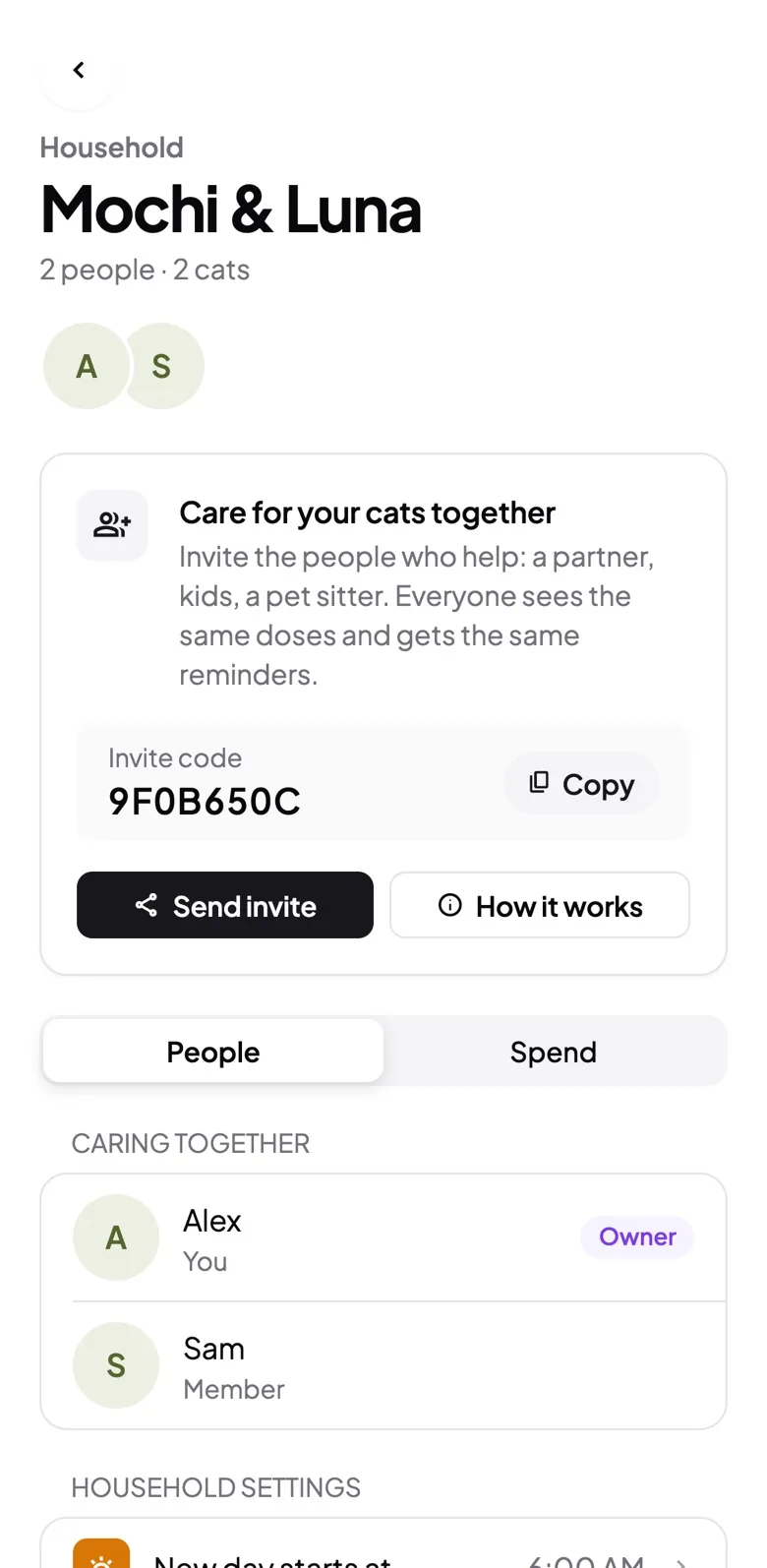
The app version of this chart, shared with everyone
Paper works until it's in the kitchen and you're at work. Tabby reminds whoever is home when a dose is due. When someone taps Given, it shows for everyone in the household, so nobody has to ask.
Bring the chart to vet visits
Take the last few weeks of charts to every check-up. Your vet can see how often doses were missed, when a new medicine started and whether the timing was steady. This matters a lot with long-term treatment. For example, a T4 blood test for a hyperthyroid cat is easier to read when your vet knows exactly when the last pill was given. If your cat has kidney disease, see our cat kidney disease care guide for what else is worth tracking.
Don't run out: note your refills
A chart is also a good place to plan ahead. Under each medicine, write roughly when the pack will run out. A few days before, order the refill or call the clinic. Some prescriptions need your vet to check your cat again before they can renew it, and that can take time to book.
Questions people ask
What should I do if I missed my cat's medication dose?
Don't give extra to make up for it. Check the leaflet or call your vet, because the right step depends on the medicine and how late you are. Write the missed dose on the chart so the next person knows.
Can I give my cat two doses at once to catch up?
No, not unless your vet tells you to. A double dose can be harmful with some medicines. Ask your vet how to get back on schedule.
How do I keep track of multiple cat medicines?
Give each medicine its own row, written exactly as on the label, with its own time. If two medicines are due together, tick each one separately. Keep one chart in one place so everyone uses the same record.
How long should I keep my cat's medication records?
There is no fixed rule. Keep them at least until your next vet visit. For a long-term condition such as kidney disease, keep them for as long as treatment lasts, so your vet can see what changed and when.
This guide is general information from a cat owner, not veterinary advice. Always follow your vet's instructions for your cat's medicine.